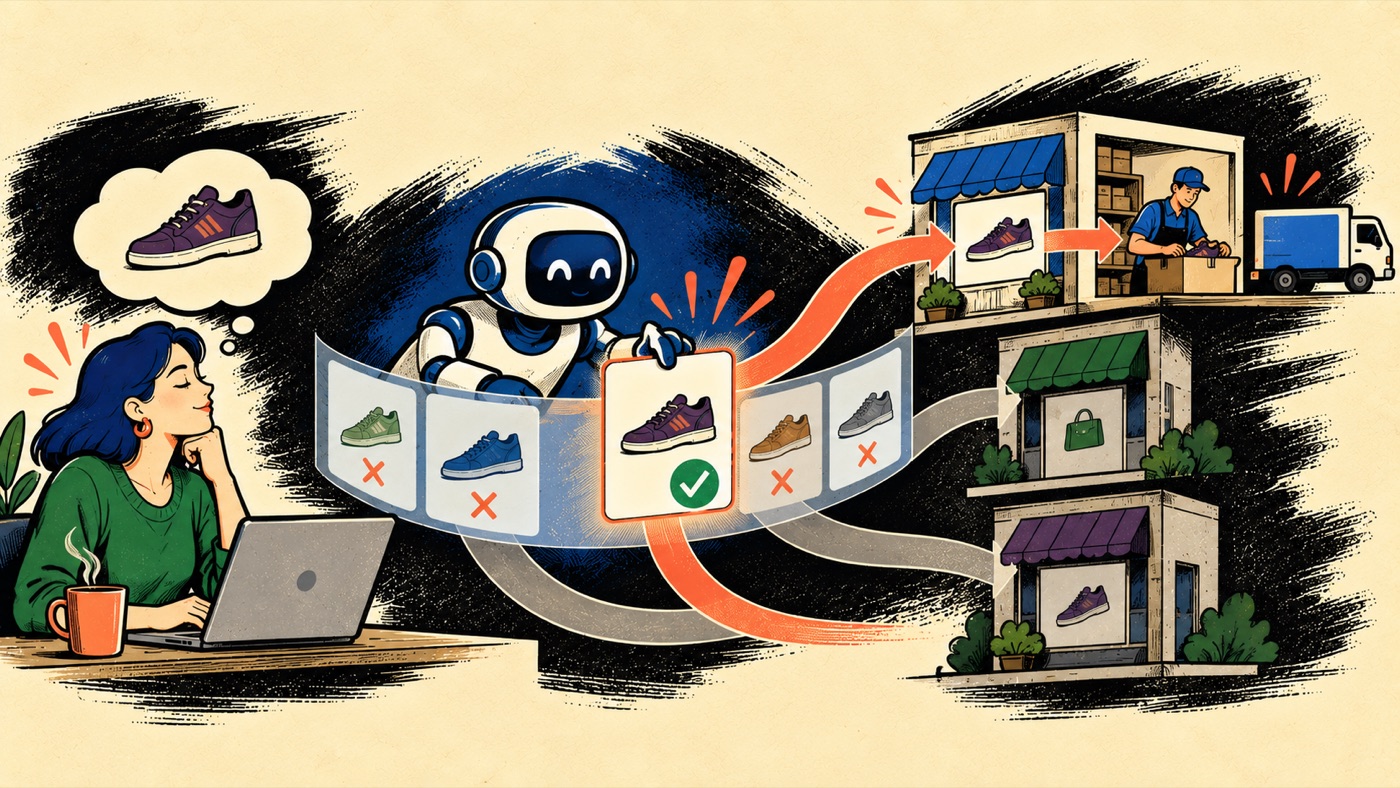
Some time ago, in an article about the future of retail in Iran and Agentic AI, I wrote that agents, AI assistants that can search and shop on a user's behalf, could make a retailer's digital storefront more intelligent.
I still think so. But several technical specifications published since then raise a more uncomfortable question: if the store records and fulfills the order, while the agent understands the need, finds the options, ranks them, and makes the final recommendation, who really owns the purchase decision?
Direct answer
Google and OpenAI both say the seller remains the Merchant of Record: the seller receives the money and remains responsible for the order. But product discovery, comparison, ranking, and even the purchasing interface may sit inside an AI assistant. The store keeps the order, but not necessarily the decision. In this environment, Retail Media must move from selling placements to influencing decisions, and brands must prepare for both the human mind and the machine's selection process.
Google UCP emphasizes that the seller remains the Merchant of Record. The seller is still the formal party to the transaction: it receives the money, issues the invoice, and handles taxes, returns, and support. At the same time, the purchase can happen directly inside AI Mode and Gemini. OpenAI's checkout architecture follows the same pattern. The seller accepts or rejects the order, but product discovery and part of the transaction interface sit inside ChatGPT.
These architectures leave transaction responsibility with the store. But owning the transaction is not the same as owning the process that shapes the decision.
The store may still collect the money, deliver the goods, and manage returns, while the AI provider, the platform operating the assistant, such as ChatGPT or Gemini, sees the user's question, constraints, candidate list, reasons for eliminating each option, and moment of choice.
In my view, this shift, rather than sales growth or conversion rates, is the central issue for Retail Media in the years ahead.
Four Layers of Power in a Purchase
To see this shift, we need to break a purchase into four layers.
- Demand formation. How are need, desire, trust, and brand preference created? This layer remains deeply human, shaped by advertising, experience, culture, and memory.
- Mission definition. How does the user communicate the need to the agent? Budget, timing, permitted brands, delivery requirements, and selection criteria.
- Candidate generation and ranking. Which products qualify? What gets excluded? Where does a sponsored offer enter the candidate list?
- Transaction execution. Who builds the cart, makes the payment, accepts the order, and handles fulfillment and delivery?
In conventional e-commerce, the store could observe much of the last three layers within its own app and website. In Agentic Commerce, commerce in which an AI assistant acts on the user's behalf, it may be left with only the final layer.
Being the Merchant of Record comes with important rights and responsibilities. But it does not guarantee that the store knows why it was chosen, which alternatives it competed against, or which offer actually changed the decision. The store may retain ownership of the order without owning the moment of decision.
AIDA Is Not Dying. It Is Being Split Between Humans and Agents
AIDA is the familiar advertising funnel: Attention, Interest, Desire, Action. Its hidden assumption is that the same person sees the message, becomes interested, develops a desire, and takes action. One person. One chain.
In Agentic Commerce, that continuity does not always hold. A person feels a need, an agent finds and compares products, a sponsored offer enters the list, the person approves the final choice, and the agent makes the payment.
For repeat purchases, the person may set a rule once and have no involvement in subsequent purchases.
So the right question is not, "Is AIDA dead?" It is: who moves through each stage?
| Stage | Human side | Agent side |
|---|---|---|
| Attention | Being seen, remembered, and brought to mind | Being found in a product catalog, an API, or an AI response |
| Interest | Curiosity and mental engagement | Assessing fit with the mission and its constraints |
| Desire | Desire, identity, trust, preference | Scoring against recorded rules |
| Action | Deciding or approving | Building the cart, paying, and executing within authorized limits |
An agent does not become interested in the psychological sense. For an agent, Interest means price, availability, seller credibility, delivery time, return terms, and warranty. Attention does not begin with a compelling headline either. The product must be discoverable and interpretable.
Desire is the hardest stage to delegate. For detergent, batteries, or other repeat purchases, preference becomes a recurring rule: "Buy the same brand as before, below this price." For clothing, travel, cars, and luxury goods, human identity and imagination remain at the center of the choice.
Brands Now Have Two Audiences
In this environment, a brand must win two competitions at once: it must be credible and memorable to people, and understandable and comparable to agents.
Put simply: human memory plus machine legibility.
The human layer wants what it has always wanted: narrative, creativity, differentiation, and experience. The machine layer wants something else: reliable prices and availability, delivery times and costs, return terms and warranties, seller credibility, installment options, bundles, reviews, and the time of the latest update.
Brand building does not disappear. In fact, a strong brand can become part of the user's constraints before the mission even starts: "Only buy this brand," or "Do not buy from an unknown seller." That is a valuable position to hold.
But the reverse is also true. An agent can shortlist a lesser-known brand because it offers a better warranty or faster delivery. Brand reputation becomes an initial assumption about trust and risk, while structured data determines whether the product makes it onto the list at all.
An advertiser that thinks only about creativity may be present in people's minds but invisible to the agent. A brand that optimizes only its data may enter the comparison but fail to create preference.
What Is Retail Media Built On, and Which Foundations Are Shifting?
Today's Retail Media Platform, or RMP, rests on four assets: human traffic; display surfaces such as search, product listing pages, product pages, the homepage, and checkout; first-party data; and a closed loop connecting ad exposure to purchase.
If shopping without pages becomes more common, the first two assets come under pressure. An agent can read a product catalog and inventory and proceed directly to checkout without opening a single page.
The store keeps the order and customer support but loses page views, onsite ad impressions, cross-sell opportunities, loyalty program exposure, and the entire record of the user's browsing.
This does not necessarily mean lower sales. Traffic arriving from an AI assistant may be more ready to buy and convert at a higher rate. IAB's study of AI-assisted shopping also describes a multistage journey: AI narrows the options and builds confidence, but users still visit other touchpoints for reassurance.
Let me be precise: the immediate risk to an RMP is not lost sales. It is the separation of demand formation from the transaction. Before the store loses sales, it may lose its media economics and visibility into the decision process.
Display Space Is No Longer the Scarce Asset
On the human web, Retail Media sold placements. If an agent considers only a handful of options among thousands of products, something else becomes scarce: the right to be included in the decision set.
We can already see signs of this transition:
- Google Direct Offers lets the retailer define the product and offer terms, while the AI environment decides when the offer is relevant and should be presented.
- Shopify Promoted Placements inserts a sponsored offer into the product catalog response and, in its pilot version, charges a commission on attributed purchases.
- Amazon Sponsored Prompts still operates with impressions, clicks, and a pay-per-click model.
These three products are not equivalent. They are different signals from a market still caught between traditional media units and outcome-based models.
Every RMP faces one strategic question: will commercial offers enter the agent's decision through the store's own infrastructure, or will the store and the brand have to pay another AI provider to reach the same customer?
Four Pressures Already Underway
Shrinking human display space. Every purchase made without a page creates fewer opportunities for search ads, banners, and cross-selling.
Fragmented data. The AI provider sees the user's intent, prompt, and deliberation process; the store sees the transaction, delivery, and returns. Neither has the full picture.
A shift in selection power. The provider can determine which products qualify, which options are considered, how the recommendation is formed, and in what order it is presented, even when the retailer fulfills the order.
A double tax on the brand. The advertiser pays once to appear in the AI response and again for advertising inside the store. Then both platforms claim credit for the same sale.
And a Conflict We Would Rather Not Discuss
If the agent belongs to the store itself, does it represent the customer, or does it sell advertising space?
Take this seriously, because this is the most likely first form of Agentic Commerce in Iran: a shopping assistant inside a marketplace or super-app.
In that setting, one player holds three roles at once. It controls ranking, sells advertising space, and reports the effectiveness of that same advertising. This conflict already existed in the world of human clicks, but at least the user could see the page and the "Ad" label.
When the agent returns just one sentence, "I recommend this", even that transparency disappears. Every paid recommendation must be clearly labeled, and the basis for selecting it must remain explainable. Not because a regulator demands it, but because once users discover an undisclosed commercial influence, they will stop trusting the store's assistant.
An agent that ranks, sells the placement, and reports its own effectiveness is not a new problem. It is an old conflict with the "Ad" label removed. The three-role problem
Higher Conversion Does Not Necessarily Mean More Value
An agent may bring less traffic, but visitors who are more ready to buy. Conversion rates rise, and everyone is pleased.
That alone proves nothing. The agent may simply be delivering demand that would have converted anyway.
The channel's real economics lie in the margin it actually adds, compared with a world in which the channel did not exist:
- Margin from genuinely additional orders
- Minus discounts and platform or referral fees
- Minus fulfillment, shipping, and return costs
- Minus sales shifted from the store's own channels rather than added
- Minus lost advertising revenue
- Plus genuinely new advertising revenue
Without this calculation, you may celebrate a channel that ultimately takes money out of your pocket. I will return to this in more detail in Part Three.
Where Will This Shift Begin in Iran?
The first wave of Agentic Commerce in Iran is unlikely to come from fully autonomous, global shopping. More immediate paths include:
- Shopping assistants inside marketplaces or super-apps
- Agents connected to wallets, installment purchasing, or closed-loop credit
- Intelligent price and availability comparison tools
- Tools that operate the user's browser on their behalf
- Shopping inside messaging apps
- Enterprise agents for recurring purchases
Poor product data, fluctuating prices and availability, uneven seller quality, product authenticity concerns, and restrictions on automated payments will slow the growth of fully autonomous experiences. Yet these same problems make reliable, machine-readable data more valuable.
An Iranian retailer's defensible asset is not page views. Seller credibility, actual inventory, delivery times across Iran, Persian-language reviews, price history, warranties and authenticity, installment options, and return rates are data no agent can make a sound decision without, and cannot find elsewhere.
If agents access these assets through an official gateway with clear economic rules, the RMP moves from the page level to the infrastructure level.
If those assets are handed over for free to a layer that controls discovery, ranking, and advertising, the store is reduced from a marketplace and media platform to a warehouse and courier service.
Iranian stores have already ceded part of product discovery to Google, Torob, and social networks. Agents do not create this problem. They deepen it.
Three Decisions to Make Now
1. Measure human media and Agentic Commerce separately. Human impressions, machine exposure, and commercial outcomes are three different units. Mix them in one report, and the contamination will reach your predictive models.
2. Define your own agent gateway and data contract. Product catalogs, offers, loyalty programs, and checkout should not be made available without rules for identity, attribution, and economics. If you do not define those rules, someone else will.
3. Manage decision power as carefully as transaction power. Remaining the Merchant of Record is not enough. You need to know where the candidate list is created, who controls ranking, and which platform sees the reason for the choice.
From Buying Attention to Owning the Decision
Agentic Commerce does not end brands, AIDA, or Retail Media. It splits each into two layers: human memory and desire alongside machine discovery and evaluation. The store may still collect the money, deliver the goods, and keep the customer's name in its database. But if the need, options, ranking, and recommendation are formed elsewhere, it has ceded a more important source of power.
The main question is no longer, "Who recorded the sale?" It is:
Who shaped the decision, who was able to change it, and who can prove their impact?
In the next part of this series, I turn to the data layer: when an agent shops on a user's behalf, which parts of its behavior truly belong in that person's profile?
Take the next step