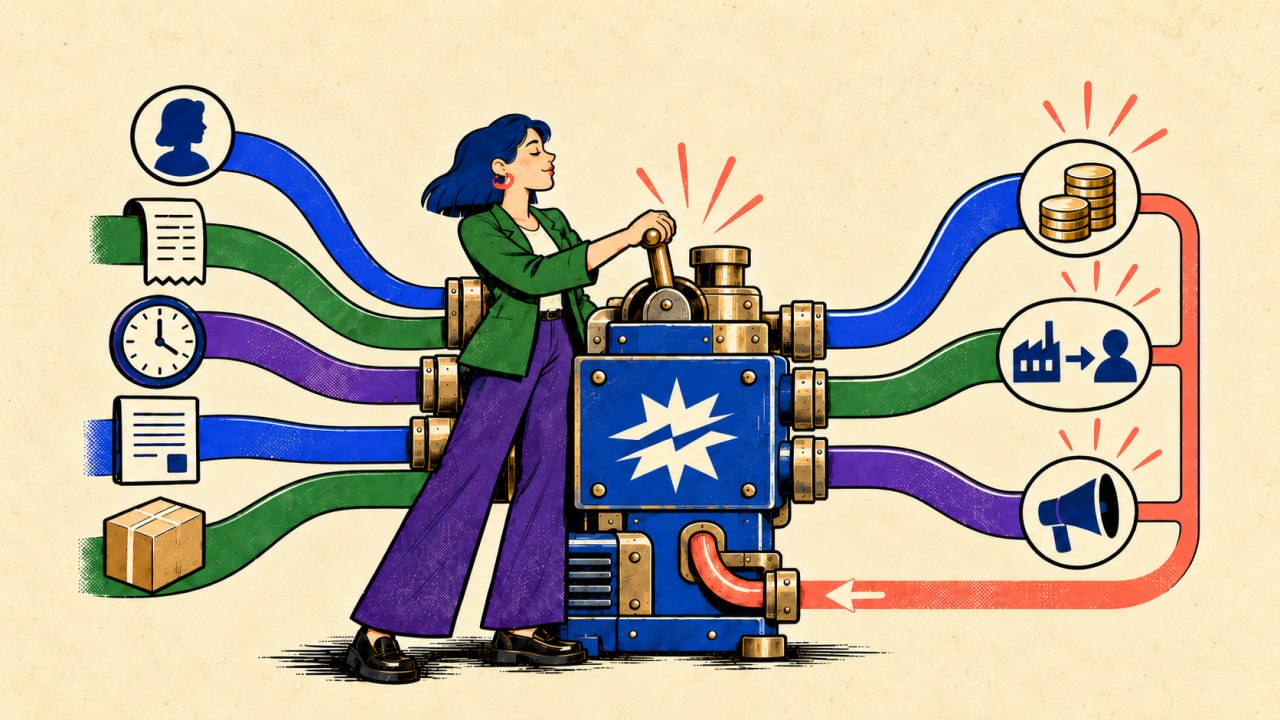
For years, we have understood CDXP through a familiar picture: customer data is collected from multiple sources, a Single View of Customer is created, audiences are segmented, and campaigns and customer journeys are activated.
Direct answer
CDXP's real potential is not another marketing message. The same architecture, identify an entity, record what happens to it, compute its traits, learn from outcomes, and use that to inform the next decision, can also decide credit limits, financing terms, and advertiser recommendations. That turns CDXP from a marketing tool into decisioning infrastructure.
But what if we applied the same architecture to other decisions? Alongside asking, "What message should we send this customer?", we could also ask: How much credit should we extend to this customer? Under what terms should we finance this supplier? What should we recommend to this advertiser? This is where the broader potential of CDXP begins to emerge.
These questions point to a more general and much bigger idea: identify an entity; record what has happened to it; compute its traits; learn from past outcomes; and use that knowledge to inform the next decision. In other words: Profile → Event → Trait → Score → Recommendation → Decision → Action → Outcome
That entity could be a customer, supplier, buyer, advertiser, or even the financial relationship between multiple businesses.
This shift in perspective turns CDXP from a marketing tool into decisioning infrastructure, which is where much of our daily work at Binoban is focused.
Let me make the point through three examples:
1. BNPL: from default risk to the right credit decision
Imagine a BNPL business with years of data: customer purchases, credit amounts, merchants, installments, delays, payments, in-app behavior, and responses to reminders.
The classic question is: How likely is this customer to default?
The more valuable question is: What credit limit and repayment term should we offer this customer so that the plan remains affordable for them and economically viable for the business?
These are different questions. The first is Prediction. The second is Decisioning.
Two customers with similar risk scores do not necessarily require the same decision. Adjusting the due date may work better for one, while reducing the credit limit may be more appropriate for another. Data and models help us evaluate the options; the actual outcome tells us how sound the decision was.
2. Supply Chain Finance: from settlement estimates to financing terms
In Supply Chain Finance (SCF), the subject is no longer a single customer. The supplier, buyer, invoice, and history of delivery and payment are interconnected.
The system can estimate: When is this invoice likely to be settled?
But the main decisioning question is: How much of the invoice should we finance, for how long, and under what terms?
Answering it requires us to consider the supplier's liquidity needs, the history of the commercial relationship, the buyer's behavior, and the amount of capital at risk.
At this point, we are no longer looking at a credit dashboard. We are moving toward Financing Decision Intelligence.
3. Retail Media: from budget prediction to the next best recommendation
In Retail Media, every advertiser also has a history: which products they promoted, how much they spent, which audiences they targeted, and what results they achieved.
A model can answer: How likely is this advertiser to reduce its budget next month? Useful, but no decision has been made yet.
The more interesting question is: What change in the promoted product, audience, or placement should we recommend to help the advertiser generate a better return from its budget?
An increase in budget can follow improved performance. The real value of the recommendation lies in the result it creates for the advertiser.
This is where data moves from "reporting what happened" to "recommending what should be done." The decisioning shift
From understanding to decision
The first part of this path is about understanding and prediction:
- What happened? Analytics
- Who is this individual or business? Unified Profile
- What is likely to happen? Prediction
- What led the model to this conclusion? Explainability
The real leap comes from answering the next two questions:
- What should we do now? Next Best Action
- How much can this action change the outcome? Uplift / Decision Intelligence
The final question is the hardest because correlation is different from the actual impact of an intervention. To claim that "Action X increases the probability of success by Y percentage points," we must execute the action, record the outcome, and measure the change through experimentation, counterfactual analysis, or uplift modeling.
Where Binoban fits
This is where we see Binoban. From the beginning, Binoban has been more than a platform for running campaigns and segmenting audiences. Its architecture is built around Data, Identity, Profiles, Events, Computed Traits, Segmentation, Intelligence, Measurement, and Decisioning.
Binoban's existing foundations turn fragmented data into usable profiles. Its intelligence layer is evolving on top of the same foundation: outputs from Binoban models or customer-specific models become scores and recommendations, enter operational workflows, and feed their results back into the system.
For example, a customer's risk score can sit alongside their behavioral history; the appropriate action can then be selected and executed according to business rules; and the customer's payment or response can be recorded in the same profile to inform future decisions.
Every industry still requires its own specialist models and business rules. Binoban's role is to connect data, understanding, decisions, and actions within one operational infrastructure.
The future is an Enterprise Decisioning Layer
This is why the future of CDXP may look less like a marketing tool and more like an Enterprise Decisioning Layer: infrastructure that understands history, models the present, evaluates the likely outcomes of decisions, and ultimately asks, "Given what we know, what can we do better now?"
This is where Binoban's promise, "Future in your hands," becomes actual product behavior. The point is simple: let's start moving CDXP beyond marketing.
Take the next step