
The first order changes the relationship
A first purchase gives the business a new responsibility: help the customer receive value from what they bought. The next useful contact may concern delivery, setup, replenishment or a related need. A fixed delay after payment cannot represent all of those situations.
Imagine three customers who bought the same lamp. One has received it and asks about a compatible bulb. Another is still waiting for delivery. The third has opened a damage claim. Their purchase category is identical. Their next useful steps are different. A second-purchase journey should preserve those differences.
Define a second valid purchase
Choose the outcome before drawing the journey. A second payment attempt, replacement shipment or extra line item in the original basket is not necessarily another purchase. Define a distinct qualifying order and decide how cancellations, exchanges and returns affect it. Keep the definition consistent in audience rules and reporting.
The observation window needs a business reason. A consumable can create a replenishment opportunity soon; a durable product may create an accessory need much later. Use historical patterns and customer feedback to form a timing hypothesis, then evaluate it. A convenient calendar interval is not evidence that the customer is ready.
Build the first-purchase audience carefully
A useful starting definition is exactly one valid order in the available reconciled customer history, with that first order in the intended period. Counting only this month’s orders can accidentally include established customers. Where history coverage is incomplete, label the limitation instead of presenting the audience as certainly first-time.
Add delivery, service, contact permission and recent-contact conditions as needed. Keep commercial eligibility separate from eligibility for a particular channel. Preview both included and excluded fictional profiles so the owner can explain why each person receives, waits for or exits the next step.
Let progress determine the next step
For a delivered order with no open issue, start with useful product guidance. If the customer then expresses a relevant need, a compatible accessory can be appropriate. For an undelivered order, provide accurate delivery information through the proper service process. For an open complaint, route attention to resolution before promotional selection.
These branches are design choices, not universal rules. A service case may require a different response according to its severity and context. Keep the customer’s expressed preference and the business’s support policy visible. The journey should allow waiting and human review when the evidence is incomplete.
| Customer state | Useful next step | Recheck before contact |
|---|---|---|
| Delivered; no open issue | Product guidance | Permission and recent contact |
| Awaiting delivery | Delivery update | Latest shipment status |
| Open damage claim | Service resolution | Case status and support policy |
| Second purchase completed | Exit this journey | Pending actions and next lifecycle state |
Treat the journey as a sequence of decisions
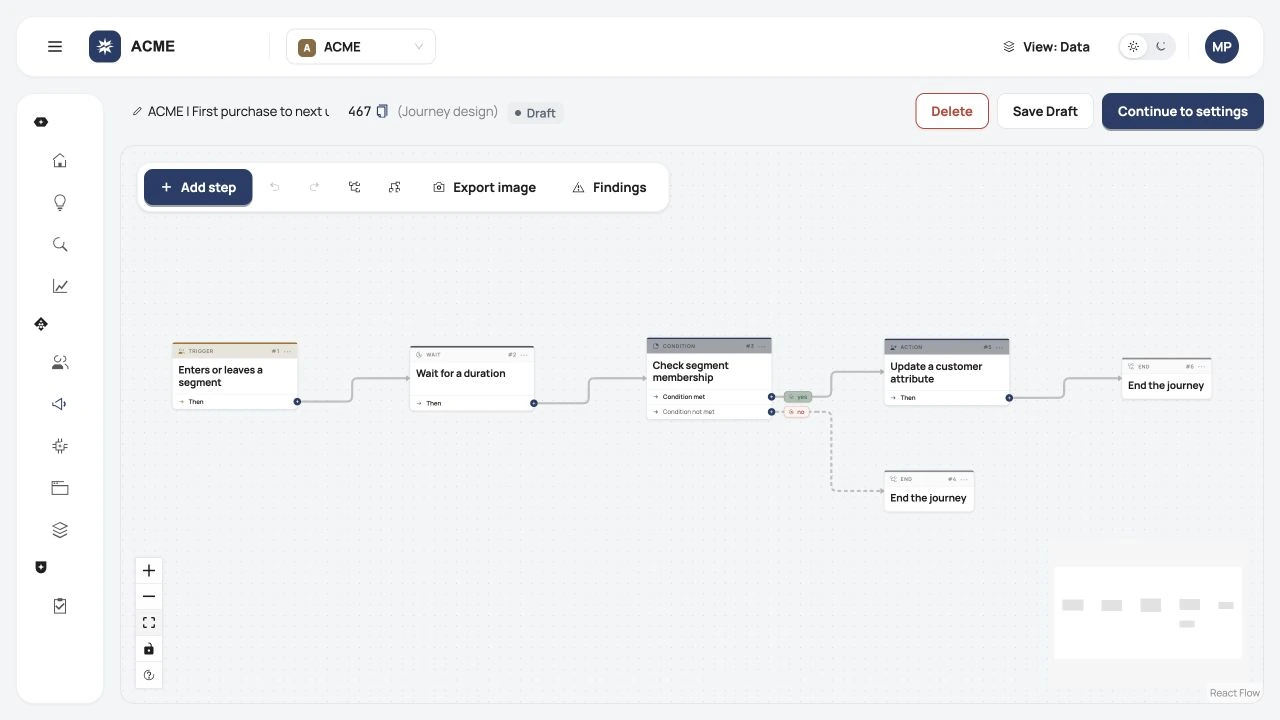
A practical sequence is: recognize a qualifying order; wait for the relevant delivery evidence; check service and contact conditions; offer guidance; wait for the next meaningful signal; re-evaluate; then consider a suitable next product. Record what evidence each step consumes and what invalidates it.
A second purchase should stop the first-to-second-purchase path. Cancellation, return or a changed permission may require a different exit. Define re-entry explicitly so a replayed event does not start the same customer repeatedly. Inspect pending actions when the customer exits, especially if a separate channel system holds a send queue.
Choose timing, channel and benefit together
Use available permitted channels, local time and contact history to decide how to reach the customer. A reminder sent to an unreachable address is not a completed contact. A fallback channel needs permission and a fresh eligibility check. Set a combined contact policy so other campaigns do not overwhelm the same customer.
Start with the customer’s friction when considering a benefit. Guidance may solve uncertainty without reducing price. A shipping benefit may address a known delivery-cost concern. A discount has a cost on every qualifying redemption, including purchases that would have happened anyway. Evaluate the policy’s additional contribution, not only coupon use.
Evaluate the journey with a stable cohort
Track the rate of second valid purchase within the chosen window, time to that purchase, contribution after variable costs, returns and unwanted-contact indicators. Keep the cohort denominator stable. Removing people from analysis because they bought and exited the journey would remove the very outcome being measured.
When feasible, assign eligible customers randomly to the proposed journey and a defined holdout before activation. Preserve necessary service communications in both groups. The comparison then addresses the journey’s incremental effect under the test conditions. Record uncertainty and check whether the gain remains worthwhile after incentive and delivery costs.
Make the first version reviewable
Start with one category, one outcome and a small set of understandable branches. In Binoban, build the corresponding audience and draft journey using fictional profiles before connecting any live send. Review the path for the delivered buyer, the waiting buyer and the customer with an open issue. Then change their state and inspect the next decision.
A useful second-purchase journey gives the team a commercial objective while following the customer’s actual progress. Its quality becomes visible in the moments when a message changes, waits or stops because the relationship has changed.
Take the next step