
A segment has a lifecycle too
Someone qualifies for a first-purchase campaign at nine in the morning and completes an order at ten. If the audience remains a fixed export, the campaign may keep offering an incentive for a purchase that has already happened. The rule was reasonable when it was written. Membership became outdated.
A dynamic audience evaluates customer evidence again as the relevant data or time conditions change. Designing it means specifying who enters, who exits, how often the rule is evaluated and where the membership is used. The evaluation method matters as much as the filter itself.
Write a business definition before opening the builder
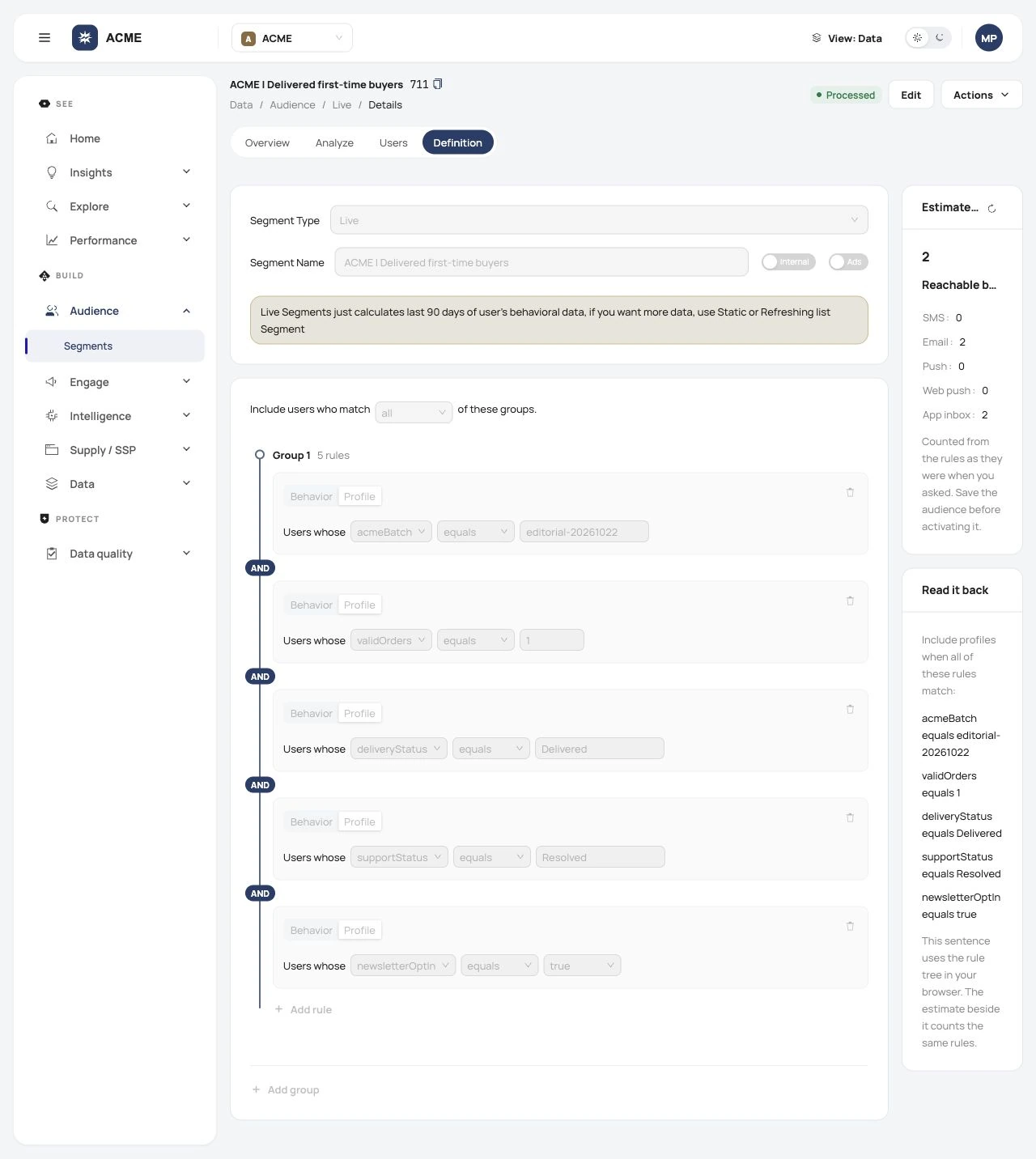
Consider a post-purchase audience: customers with exactly one valid lifetime order, delivered between seven and twenty-one days ago, with no open service issue. “One purchase in the last month” is a different definition: a long-standing customer may also have bought once that month. State the history coverage you need and what happens when older records are unavailable.
Use names that expose meaning. A rule called “Delivered first-time buyers, 7–21 days” is easier to review than “High potential.” Define the qualifying order, cancellation and return treatment, date field, timezone and handling of unknown values. Avoid allowing an empty support status to silently mean that every issue is resolved.
Match the audience type to the decision
A fixed set is useful when you need a reproducible snapshot, such as the customers assigned to an experiment. A scheduled refreshing list suits recurring calculations and relative-time rules. A live audience suits supported conditions that must react to incoming behavior. Each type has its own supported operators, time limits and processing behavior.
In Binoban’s stage interface, the segment picker distinguishes Live, Refreshing list, Static, Uploaded list and In memory. Choose according to the available rule support and the required freshness. A label such as Live does not establish an end-to-end delivery guarantee: measure when changes reach the consumer of the audience.
Make exit conditions first-class rules
A new valid purchase should remove someone from a one-purchase audience. A service case can temporarily suspend promotional eligibility. A revoked permission can remove the customer from an allowed-channel audience. Write these exits alongside the entry rule, including whether a later change permits re-entry.
Membership and experiment assignment are different. If a person exits an activation audience after buying, their original experiment assignment should still be retained for analysis. Otherwise, removing successful buyers can distort the comparison. Store the cohort definition and assignment independently from the changing send list.
Test people, not just the audience count
Build a small fictional fixture before launch. Include a qualifying customer, a customer with two purchases, an undelivered order, an open support issue, a revoked permission and a missing date. For each, write the expected membership. Check the actual result and inspect the underlying evidence when it differs.
Then change one fact at a time. Give the qualifying customer a second order and verify the exit. Close the support issue and check the re-entry rule. Advance the relative-time boundary. Count changes alone can conceal the wrong people entering and leaving at the same time.
| Fictional customer | Evidence | Expected decision |
|---|---|---|
| Maya Chen | One valid order; delivered; no open issue; opted in | Include |
| Omar Patel | Second valid purchase completed | Exit |
| Sara Reed | Awaiting delivery | Wait for delivery |
| Leo Park | Open service issue | Pause promotion |
| Nora Alvarez | Promotional permission withdrawn | Exclude from promotional contact |
Keep channel eligibility and shared use explicit
A useful commercial audience is not automatically a sendable audience. Apply the permission, address validity and reachability checks required for each channel. Keep transactional service communication separate from promotional selection. The appropriate basis for one purpose does not automatically apply to another.
When several journeys consume the same definition, record ownership, version and downstream dependencies. A small rule change can affect several campaigns. Preview the change, compare included and excluded customers, and document how already-queued actions will be handled.
Use a short release checklist
Before activation, the owner should be able to explain the definition, source data, refresh behavior, expected size, key exclusions and destinations. Keep a few reviewed fictional profiles as regression examples. A customer-state change should produce an explainable membership change, followed by a verified destination update.
Start with an audience whose business meaning is easy to challenge. Build it, preview it, change the fictional evidence and inspect the result. The goal is a reusable definition that continues to represent the customer as the relationship develops.
Take the next step